SmartVent: The Hidden Roof Upgrade Every Home Deserves
If your attic gets uncomfortably hot in summer, if you notice icicles hanging from your eaves in winter, or if your shingles look older than they should, the problem may not be your roof. It may be what your roof can’t do: breathe.
Most homeowners never think about attic ventilation. It sits quietly above the ceiling, out of sight and out of mind. But the moment ventilation fails, the symptoms show up everywhere else, on your shingles, on your ceilings, in your energy bills, and sometimes inside your walls as mold and rot. The good news is that fixing it doesn’t have to mean tearing off your eaves or redesigning your house. A modern product called SmartVent solves the problem with a small, almost invisible change at the edge of your roof.
Why Your Roof Needs to Breathe
A healthy roof works like a chimney. Cool, dry air enters low at the eaves, sweeps up under the roof deck, and exits high at the ridge. That continuous airflow does three important jobs. In summer, it carries scorching attic heat outside before it cooks your shingles from below and drives up your cooling costs. In winter, it keeps the underside of the roof cold enough that snow on top melts evenly instead of refreezing at the eaves and forming ice dams. Year-round, it removes the moisture that your household generates every day, from showers, cooking, and laundry, before it can condense on framing and feed mold.
This system only works if air can both enter and exit. When one side is missing or blocked, the whole thing stalls.
The Hidden Problem: Missing Intake
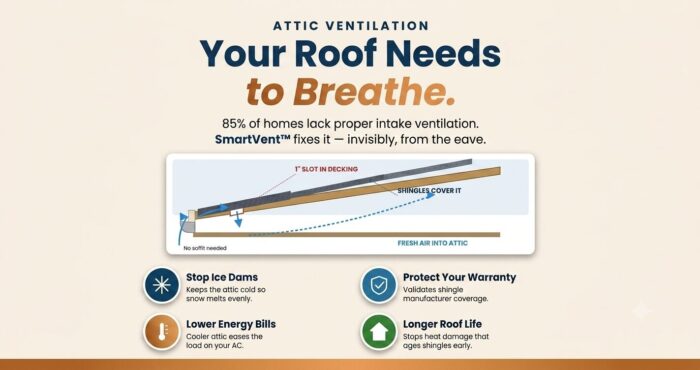
Industry data suggests that up to 85 percent of homes do not have adequate intake ventilation. Sometimes the home was simply built without it, common with cathedral ceilings, flush eaves, or houses that have little or no overhang. Sometimes insulation has been stuffed against the roof deck and is blocking the airflow path. And sometimes the original soffit vents were painted over, screened shut, or covered during a remodel.
Whatever the reason, the result is the same. The ridge vent at the top of your roof has nothing to pull from. Instead of drawing fresh outside air, it starts pulling conditioned air from inside your home, the air you just paid to heat or cool, right out through the attic. The attic stays hot, moist, and stagnant. Shingles age faster. Ice dams form. Energy bills climb. And eventually, the shingle manufacturer can deny warranty claims because the ventilation requirements were never met.
What SmartVent Actually Is
SmartVent is a low-profile plastic intake vent made by DCI Products that installs directly under the first course of shingles at the edge of your roof. From the curb, you can’t see it. The shingles look exactly the way they always have. But underneath, the vent creates a continuous channel that lets fresh air enter at the eave and travel into the attic through a one-inch slot cut into the roof decking.
Think of it as adding a soffit vent to a house that doesn’t have soffits, or that has soffits which no longer work. It bypasses the overhang entirely. It works on cathedral ceilings. It works on additions. It works on dormers. And because it runs continuously along the eave rather than as scattered round vents, it delivers even airflow across the whole roof instead of in patchy hot and cold spots.
What SmartVent Fixes in Your Home
Homeowners typically notice the difference in four ways.
Ice dams disappear. Ice dams form when heat escaping into the attic melts snow on the roof, which then refreezes at the colder eaves. Once the attic stays cold and dry, that cycle stops. No more ice along your gutters. No more water backing up under your shingles.
Cooling bills drop. An unvented attic in summer can reach 140 to 160 degrees Fahrenheit. That heat radiates down through your ceiling and forces your air conditioner to work overtime. Balanced ventilation can reduce attic temperatures by 30 degrees or more, easing the load on your HVAC system.
Shingles last longer. Most asphalt shingles are rated for decades, but only when the deck underneath them is kept cool. Baked shingles curl, crack, and lose their granules years ahead of schedule. Proper intake protects the investment you already made in your roof.
Moisture and mold leave with the air. Every shower, every pot of pasta, every load of laundry releases moisture into your home, and a portion of it migrates upward. Without ventilation, that moisture condenses on cold attic framing and the underside of the roof deck, where it feeds mold and slowly rots wood. With SmartVent in place, it has somewhere to go.
Signs You Might Need It
You don’t need to climb into your attic to suspect a ventilation problem. A few common red flags:
- Icicles or thick ice ridges along your gutters every winter.
- Upstairs rooms that stay noticeably hotter than the rest of the house in summer.
- Shingles that look curled, blistered, or aged for their actual age.
- A musty smell when you open the attic hatch.
- Frost, water staining, or dark spots on attic framing.
- A home with no visible overhang, or soffits with no vents in them.
Any one of these can point to a ventilation imbalance. Two or more, and it’s worth having someone look.
What Installation Actually Looks Like
SmartVent is most commonly installed during a roof replacement, when shingles are already off and the deck is accessible. The installer cuts a one-inch slot along the eave a few inches up from the edge, lays SmartVent over the slot, and shingles right over the top of it. There is no change to your fascia, your gutters, or the appearance of your home. From the ground, your roof looks exactly the same. The only difference is what it can do.It can also be retrofitted onto an existing roof in many cases by carefully lifting the first course of shingles, though a full roof replacement is usually the cleanest and most cost-effective time to do it.
Why It’s Worth Asking About Now
Ventilation is one of the few roofing upgrades that pays you back in three different ways at once: lower energy bills, longer shingle life, and protection against the kind of moisture and ice damage that turns into very expensive repairs. It also keeps your shingle warranty valid, which many homeowners only discover matters when they try to file a claim and learn that improper ventilation voided it years ago.
If you’re due for a new roof in the next few years, or if you’re already seeing symptoms like ice dams or hot upstairs rooms, this is the right time to have your ventilation evaluated. A small change at the edge of your roof can save you a lot further down the line.
FREE ROOF VENTILATION INSPECTION
Not sure if your home has the intake ventilation it needs?Alpha Design Services will inspect your roof, check your attic airflow, and tell you exactly where you stand, at no cost and no obligation.
Email: contactus@alphadesignservices.com
Schedule your free inspection today.